

CLOCK
Studio Visit 11
Hello November
In honor of MoMA’s upcoming exhibition of Christian Marclay’s The Clock, 2010, I’m sharing an excerpt from the ICONOGRAPHY book draft I have been working on throughout 2024. This fall, I’ve been working with Maggie Taft of the Writing Space Residency to edit the book.
CLOCK
It’s pretty pointless to think about making an artwork with or about a clock after Christian Marclay made “The Clock,” or Nam June Paik’s “TV Clock.” But the first clock I made was in 2006 and it was inspired by silent film star Harold Lloyd hanging from the clocktower of a building from the oversize metal hands of the clock. (Safety Last, 1923) I made it the image of a clockface that had been burst through, where the hands (and therefore the time) were lost, busted out, out of frame. And also, there is no body in my picture, hanging on or otherwise. I might be the only one who got the joke – I recall explaining it repeatedly, which is, in fact, death to comedy – that if the center of the clock was blasted out, and along with it the clock mechanicals, and Lloyd’s body hanging on to them for dear life, then what it really is a picture of is a death, a dead body (absent, splat on the ground below, presumably), a failure to convert the violent suspense into comedy gold. How dark and downer that is. And even more so when it has to be explained.

Clocks have been in art for a long time. Clocks and their progenitors, sundials, hourglasses, other methods I’m sure I don’t know. Clock isn’t so much about time as it’s about culture. This is underlined in The Clock. The things that are (depicted as being) done in the morning, at noon, evening, overnight. Christian Marclay’s The Clock is a representation of high modern high capitalism high American 20th century time. What is 21st century time? In the book, 24/7 and the End of Sleep by Jonathan Crary the word time is mentioned 79 times, but clock only two, and one is the figure of speech “around the clock,” meaning without stop.
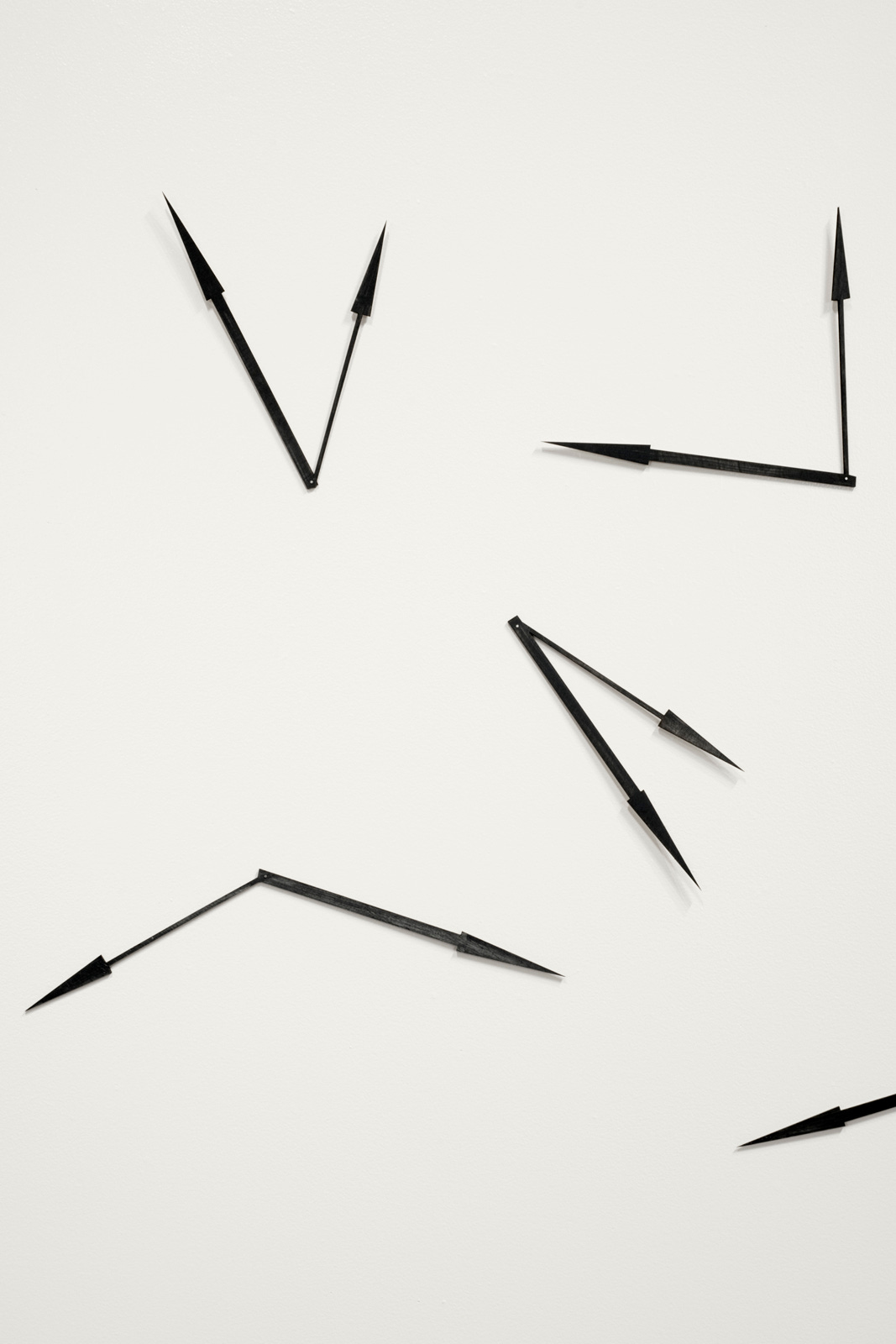
Clock as a verb - as in to clock to notice to see to eyeball. The clocking of the clock. And the hands of the clock are pointing mechanisms. Little hand, big hand. The little and big hands are lines but they are also often arrows. Arrows like the arrows that are weapons but used for pointing, like fingers.
An image of a clock or a watch is the easiest way to represent time, where a clock is collective societal time. A watch is different, it is bodily adornment, status, personal time, personal time keeping. My piece Panning (Schedule Solution) 2010 used a 9 foot diameter clock face with multiple sets of clock hands showing all different orientations and seemingly running at the same time. The clock hands were static: broken clock. The passing of time was translated into a representation of anxiety, in 2010, sort of presaging grind culture of social media.

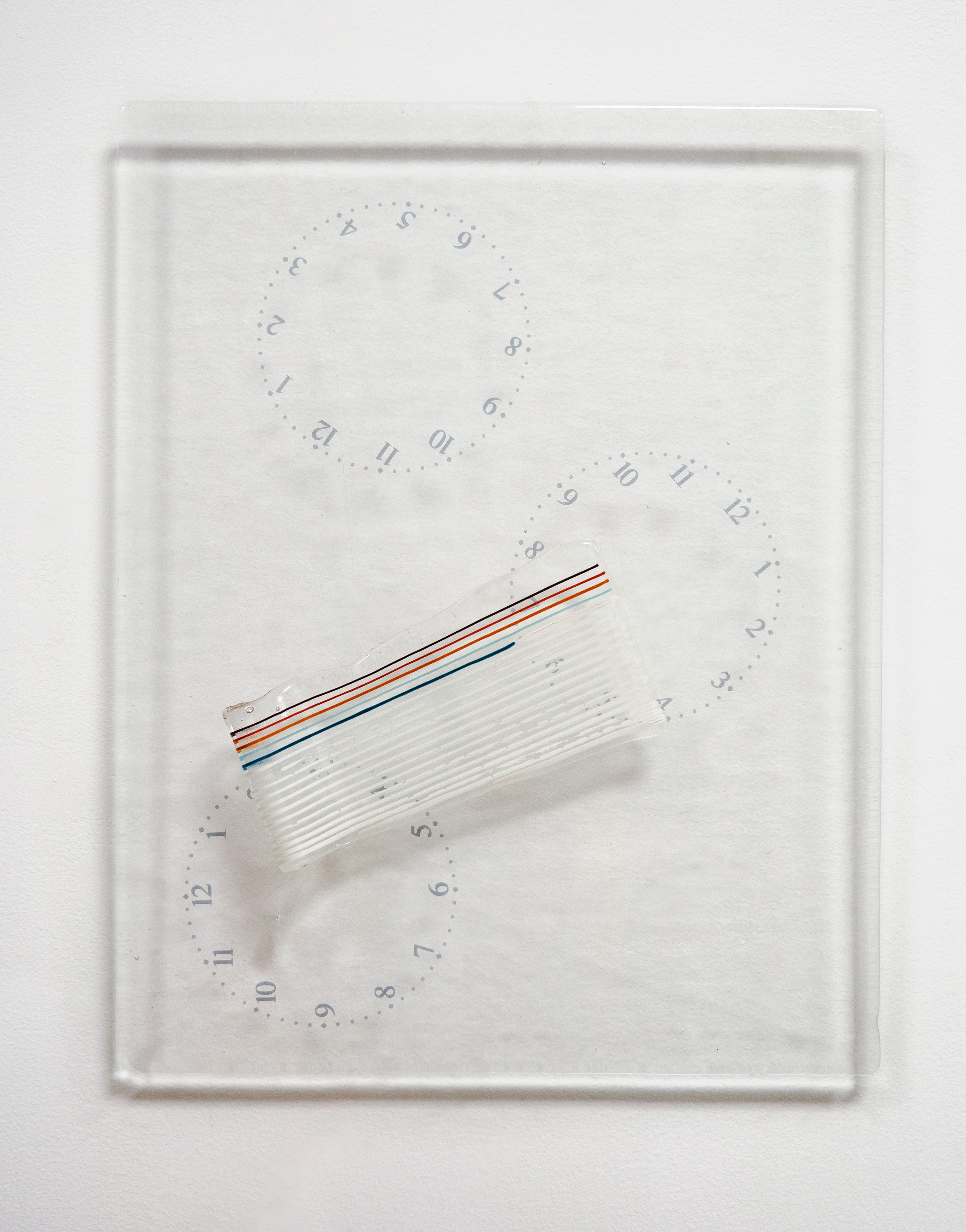
At first I did a clock without hands and then I did hands without a clock. A clock is a powerful image, but only really when it is in use, when it is running, ticking, moving both physically and metaphorically. But what is a clock FACE without clock HANDS? And why is it personified in this way.
I’m realizing now that for the most part when I use an image of a clock, I separate the hands from the face. Disembodied further so they are no longer in use together, coordinated, pointing to and at each other.
An image of a clock is by definition non-functioning, where as Marclay’s clock actually functions, and is made up of images. A clock delineates the time of now. There’s not a lot of planning, but then the whole of life is made up of these individual moments. Over and over and over and over again. In some ways its a scale issue, like a single sheet in a ream of paper.
And how it no longer really has to do with order and social function, but decor. So a clock / a watch in the 21st century have completely different meanings. Commodified time and commodified watch are two different commodities except that they are both absurd and alienating.

Further Reading
Jonathan Crary 24/7: Late Capitalism and the End of Sleep1
Christian Marclay’s The Clock
Final Note
While I’m writing about masterpiece level artworks that inspire (and inspire envy🤪), tomorrow Hunter College Department of Art & Art History is helping to sponsor a talk at the Asia Society by artist Paul Pfeiffer. Paul Pfeiffer: Prologue to the Story of the Birth of Freedom Director's Conversation Series His show at LA MOCA was one of the best retrospectives I’ve ever seen.
In-person • Sat 02 Nov 2024 • 3 - 5 p.m. at Asia Society in NYC • 725 Park Avenue (at 70th Street), New York, NY 10021
If you have the afternoon free, please come. The code ARTS5 will get your ticket.
I guess coming out in Spring in a new edition